Why fall prevention looks different in assisted living and memory care
Residents are entering assisted living and memory care communities older and with higher acuity than previous generations, according to SafelyYou’s 2026 Cost of Senior Care Study.
Staffing realities add another layer of complexity. The Cost of Senior Care Study also found that up to 40% of falls in assisted living go unwitnessed or unreported — a figure that climbs to 80% in memory care, where residents often can’t communicate when or how a fall occurs. This leaves care teams without the information they need to respond effectively, creating gaps in care that can be difficult to fill.
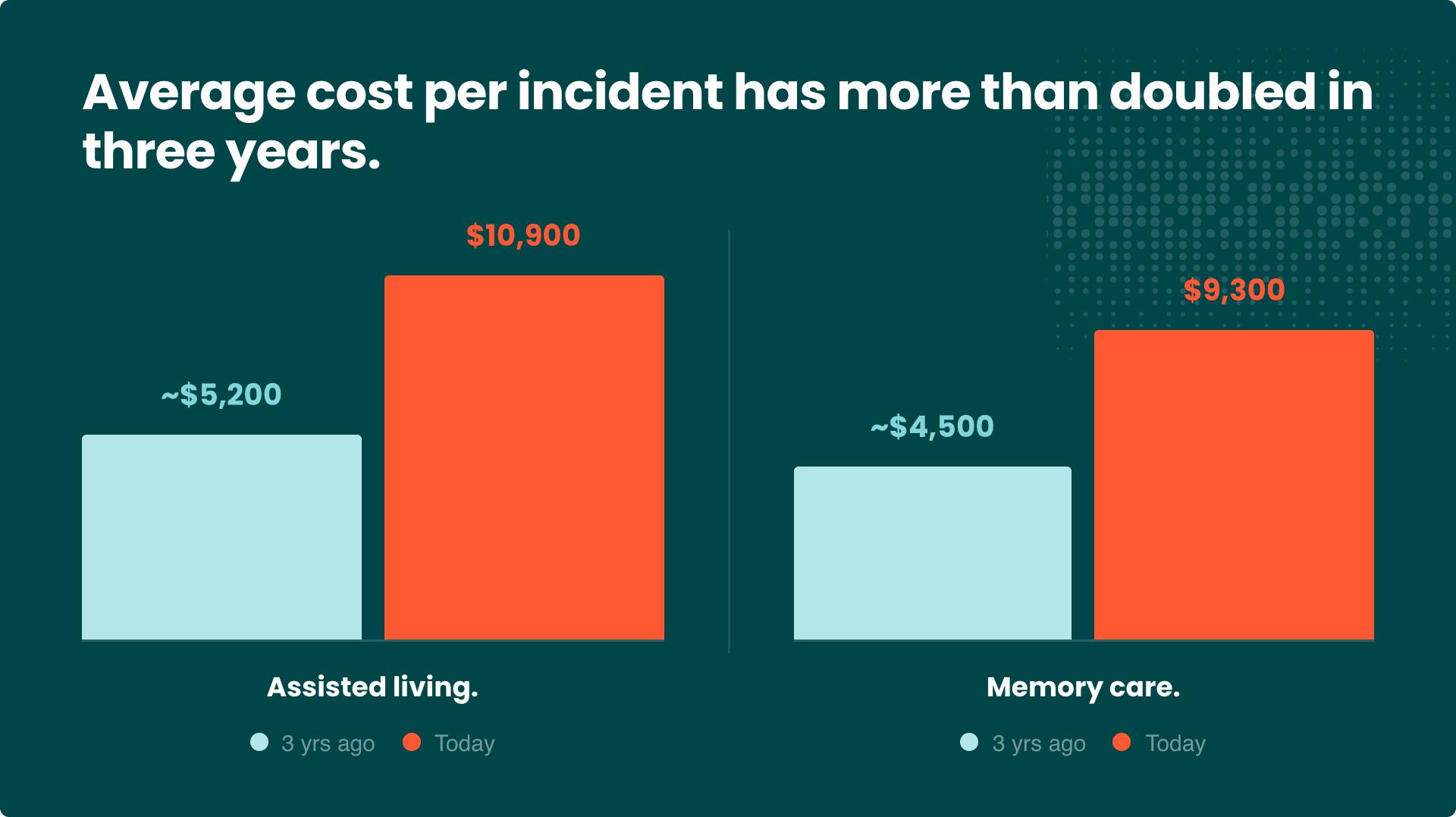
In addition to the health and wellness consequences, falls in both settings also carry significant financial consequences. The average cost per incident runs $10,900 in assisted living and $9,300 in memory care, more than double what communities reported just three years ago.
How communities and operators can help reduce fall risks in senior living
There isn’t one single answer that will end falls altogether. Rather there’s an interconnected web of solutions that can significantly change those outcomes for the better. Along with updating care plans and implementing fall detection technology, like SafelyYou Safety AI®, there are preventative measures communities can take to help reduce fall risks.
Below are five practical steps for reducing fall risks in assisted living and memory care communities, from creating a safer environment to leveraging the right technology. Together, they create a prevention approach that’s more responsive to how fall risk actually presents in this population: unevenly distributed across residents, clustered around predictable windows, and often visible in behavioral signals before an incident occurs. Most can be built into existing workflows without significant lift, and none require starting from scratch.
1. Implement targeted environment modifications
Residents with cognitive impairment in assisted living and memory care can’t reliably identify hazards or adjust their path around them. Many high-impact modifications are low-cost and quick to implement, including:
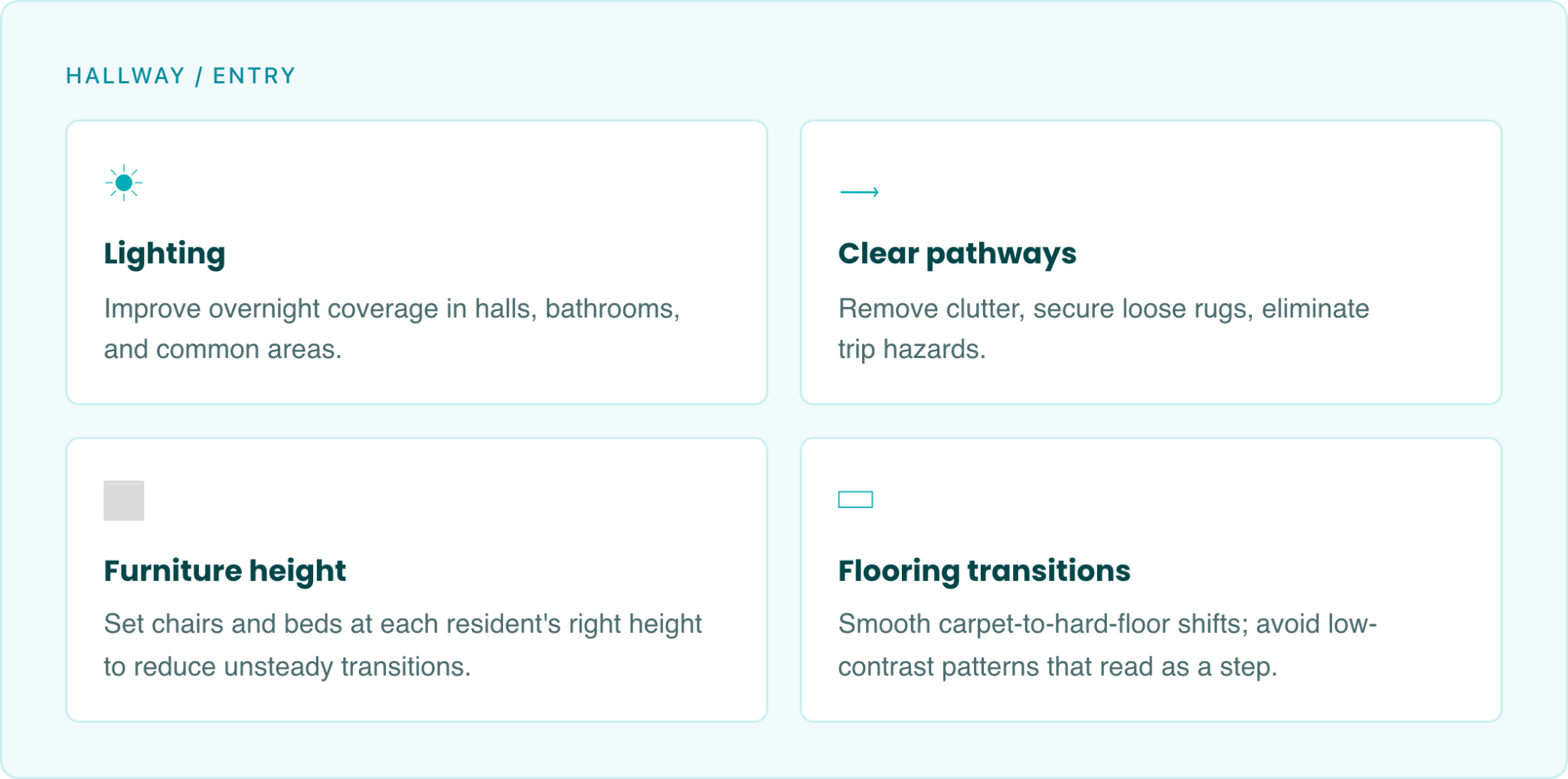
- Lighting: Improve coverage in hallways, bathrooms, and common areas, especially overnight, when disorientation and fall risk peak.
- Pathways: Remove clutter and secure loose rugs to eliminate trip hazards a resident with cognitive impairment may not register.
- Furniture height: Set chairs and beds at the right height for each resident to reduce the unsteady moments that precede many falls.
- Flooring transitions: Smooth shifts from carpet to hard floor and avoid low-contrast flooring patterns, both of which can register as a step or obstacle for residents with spatial perception changes.
A regular walk-through with fall risk in mind can surface changes that are easy to miss during a busy shift.
Educate staff on how to spot and address fall risks
The Cost of Falls Report found that education can reduce fall rates by up to 50% for those who can self-report. But that same approach doesn’t translate for residents with cognitive impairment.
Redirecting that energy is more productive. Building staff knowledge of how cognitive impairment affects judgment, spatial perception, and physical stability helps teams recognize fall risk before it becomes an incident.
Knowing a resident’s triggers also opens the door to better person-centered interventions. In one case detailed in the Cost of Falls Report, a resident who had been a top executive at a large corporation began packing a suitcase and repeatedly looking out the window, waiting for someone to arrive. Those anxious behaviors coincided with his falls.
When the care team connected those behaviors to his professional history and redirected him toward morning rounds and administrative tasks, the falls stopped. That kind of intervention requires knowing a resident’s history, identity, and sense of purpose and applying that knowledge to how care is delivered.
Match care routines to resident behavioral patterns
Fall risk among residents with cognitive impairment clusters around predictable windows, such as nighttime bathroom trips, post-meal restlessness, and late-afternoon agitation. Still, every resident’s patterns are different.
One may become most unsettled in the early evening; another resident’s highest-risk moments may come in the middle of the night. A great way to help reduce falls is to create supervision and check-in schedules around those rhythms–or having overnight monitoring in place–puts staff in the either physically or virtually in room during the windows that matter most, like when a resident is most likely to try to move without support.
Individualized supervision also surfaces changes earlier. When a resident’s usual patterns shift, it’s a signal worth noting. Catching those deviations before a fall is one of the more reliable forms of prevention available in this setting.
Create sharper documentation habits to spot fall risks earlier
Behavioral changes in residents with cognitive impairment are among the most reliable early indicators of elevated fall risk. But those signals are only actionable when they’re captured in enough detail to inform clinical decisions.
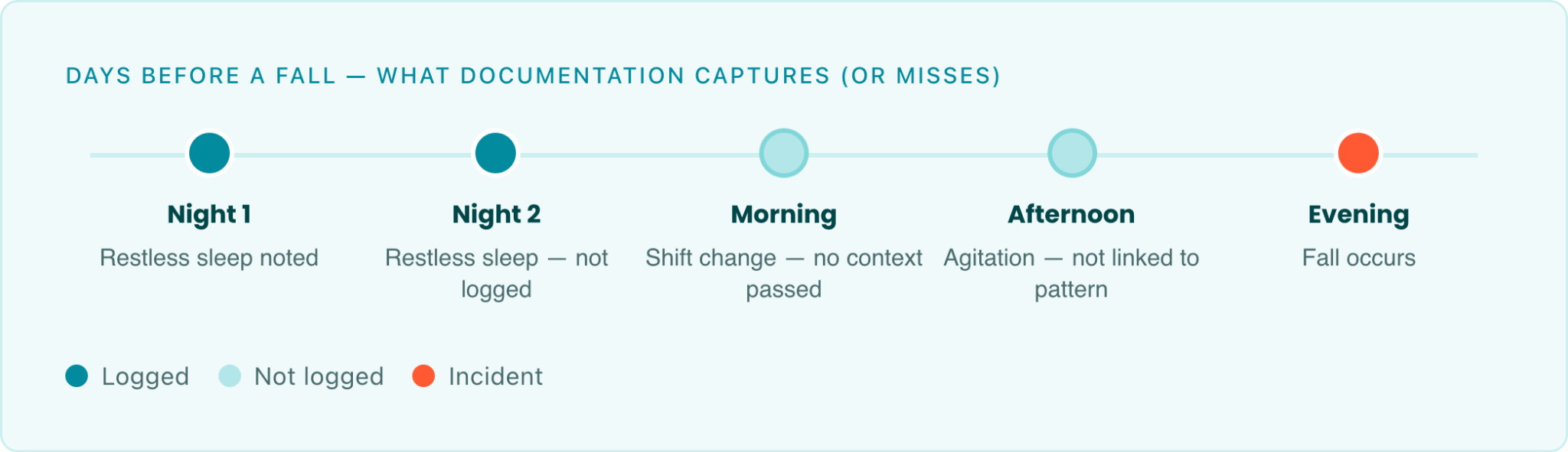
In most care settings, documentation defaults to incident recording. Staff log a fall but may not document the two nights of restless sleep that preceded it. That gap means the next shift starts without the context that might have changed how they approached the morning routine.
Use technology to monitor what staff can’t always see
Even the most attentive care team can’t monitor every room continuously. In assisted living and memory care, those unwitnessed falls have real consequences, but the information needed to prevent the next fall often never surfaces.
AI-enabled fall detection closes those blind spots. Cameras monitor continuously, capturing on-the-ground events that occur overnight and in the moments between scheduled check-ins.
The result is a meaningful shift in response time. Among communities using AI tools, 93% report faster response to falls. That faster response also changes how staff spend their time. Technology that catches more in real time gives staff that time back, directing energy toward prevention rather than reaction.
Give your care team what it needs to prevent falls
The right prevention approach to reduce falls doesn’t require more staff or a complete operational overhaul, but rather requires the right information reaching the right people at the right time. Communities that connect environment, routines, documentation, education, and technology into a coherent system give their care teams what they need to get ahead of falls rather than respond to them. That shift changes outcomes for residents, and it changes what the work feels like for the people delivering care.
These strategies are grounded in a clear understanding of the population they serve. For a deeper look at that risk profile, check out Part 1 of this series, “Cognitive impairment drives elevated fall risk across assisted living and memory care.”
Frequently Asked Questions
Do I need to overhaul my community’s operations to reduce fall risk?
No. Most of the strategies that move the needle on fall risk — adjusting lighting, securing rugs, aligning check-in schedules with resident behavioral patterns — can be built into existing workflows without significant lift. The goal is connecting environment, routines, documentation, education, and technology into a coherent system, not starting from scratch.
Does staff education actually reduce falls in memory care?
Standard fall prevention education — the kind that relies on residents being able to self-report — can reduce fall rates by up to 50% for those who can communicate effectively. But that approach doesn’t translate for residents with cognitive impairment. What works instead is building staff knowledge of how cognitive impairment affects judgment, spatial perception, and physical stability, and pairing that with a deep understanding of each resident’s history and identity. In one documented case, a former executive’s anxious behaviors — packing a suitcase, watching for someone to arrive — were connected to his professional identity. When staff redirected him toward morning rounds and administrative tasks, the falls stopped.
When are residents with cognitive impairment most at risk of falling?
Fall risk clusters around predictable windows: nighttime bathroom trips, post-meal restlessness, and late-afternoon agitation. But the specific timing varies by resident — one may be most unsettled in the early evening, another in the middle of the night. Matching supervision and check-in schedules to those individual rhythms, or having overnight monitoring in place, puts staff physically or virtually in the room during the moments that matter most.
What does good fall prevention documentation actually look like?
Most care settings default to incident recording — staff log the fall, but not the two nights of restless sleep that preceded it. That gap means the next shift starts without the context that might have changed how they approached the morning routine. Effective documentation captures behavioral changes before an incident occurs, and is specific enough to drive the right response. For example, knowing whether a resident lowered themselves to the floor intentionally versus falling changes the intervention entirely.
Can AI-enabled fall detection actually change outcomes for residents?
Yes. Among communities using AI tools, 93% report faster response to falls — a meaningful shift given that the industry average response time is around 40 minutes. Beyond faster response, continuous monitoring captures events that occur overnight or between scheduled check-ins, surfacing information that can inform prevention rather than just reaction.