
Dementia and other cognitive issues raise fall frequency by a significant margin
Compared with the general older adult population, residents with dementia fall at a much higher rate, given that cognitive impairment affects mobility, judgment, and hazard awareness. In fact, the margin is larger than most care teams expect.
For older adults broadly, more than 1 in 4 experience a fall each year¹. That rate doubles to about four times per year for residents with Alzheimer’s and other forms of dementia, according to SafelyYou’s Cost of Falls Report.
This risk isn’t confined to memory care. The 2026 Cost of Senior Care Study found that fall-related incidents in assisted living cost an average of $10,900 per incident — higher than the $9,300 average in memory care — a distinction that reflects how significantly cognitive impairment shapes fall risk wherever it appears.
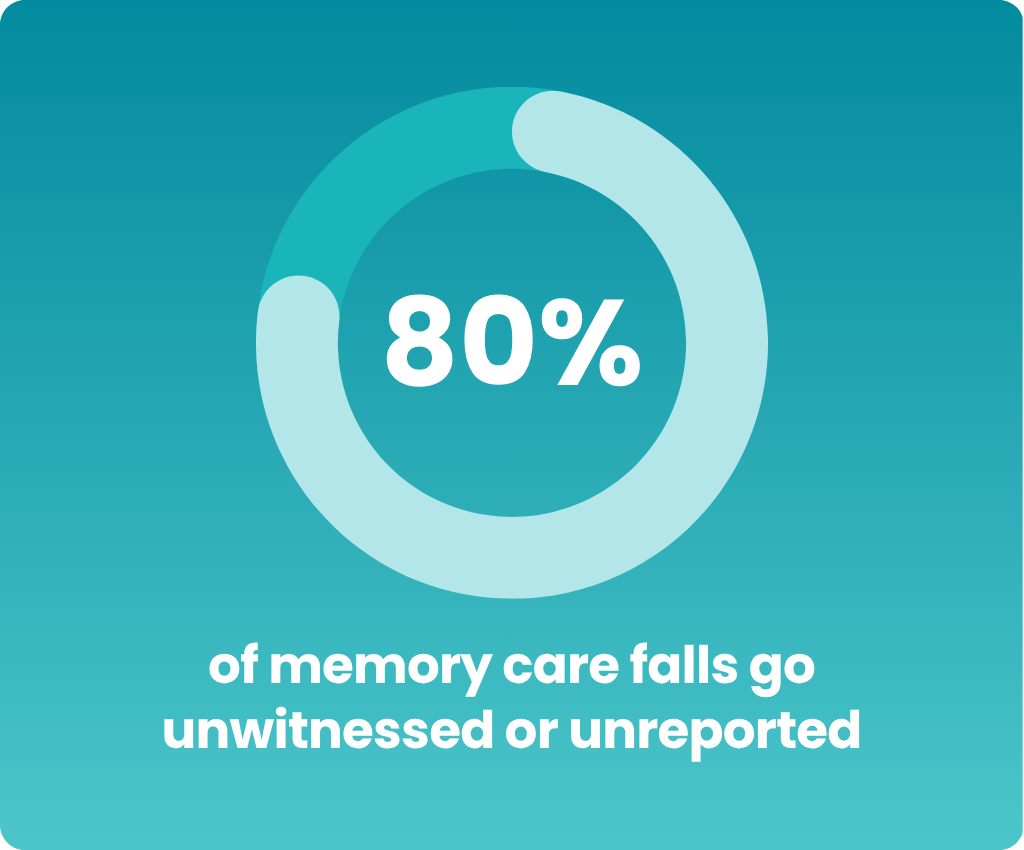
And that just accounts for the documented falls. The same study showed that up to 80% of memory care falls and up to 40% of assisted living falls may go unwitnessed or unreported, meaning the true scale of the problem runs even deeper.
Adding to this pressure is a changing demographic. Senior living residents are entering communities older with more complex conditions than previous generations. Across memory care and assisted living communities, that means care teams are managing a population with higher fall risk, which requires a fundamentally different clinical response than standard protocols provide.
Why fall outcomes are hard to manage
When a resident with dementia falls, care staff often lack a clear account of what led to the incident. Those with dementia typically can’t communicate how the fall happened, leaving staff to make important clinical decisions without a complete picture.
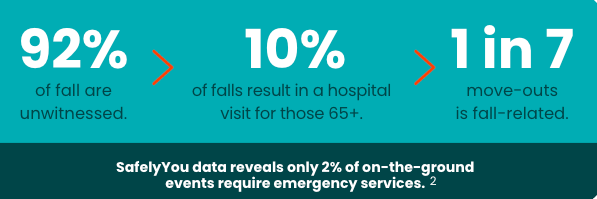
That information gap has measurable consequences for residents. Across senior living, 1 in 4 falls results in an increased level of care, while 1 in 7 move-outs is related to a fall. Residents with dementia also land in the ER more frequently following a fall, and nearly 43% of older adults treated in the ER for a fall will return for another visit — a cycle that becomes harder to break when the original incident isn’t well understood.
Beyond care outcomes, this information gap carries operational consequences for the community, including:
- Family communication demands that intensify when details of the fall are unclear.
- Incident review and care plan revisions that pull clinical staff away from direct care.
- Liability exposure that grows when falls go unwitnessed and unaddressed.
When those costs are tallied across staff time, documentation, clinical follow-up, and vacancy, they can accumulate to an average of $380,000 per community per year.
Standard protocols weren’t built for this population
Most fall prevention protocols were designed around a resident who can participate in their own safety: someone who calls for help after a fall, describes symptoms to clinical staff, and retains education about fall risk. Residents with cognitive impairments, however, can’t always reliably follow these protocols.
Education can reduce fall rates by up to 50% for residents without cognitive impairment. But the same approach doesn’t produce the same outcomes for those with dementia. Understanding their unmet needs, rather than delivering standardized programming, drives results for this population.
The same disconnect surfaces in how protocols interpret on-the-ground events. The Cost of Falls Report also found that 33% of unwitnessed on-the-ground events are intentional self-lowering, meaning residents deliberately drop to the floor rather than fall. Standard protocols aren’t designed to distinguish between the two, but that distinction is critical for designing the right intervention.
Care planning shows a similar mismatch. Functional and cognitive changes in residents with dementia can emerge weekly or daily. However, care plans across senior living are only updated every one to three months on average. As a result, leaders consistently report missing early warning signs, such as subtle gait changes, disrupted sleep, and withdrawn behavior, that are only recognized after an incident.
The picture is changing for assisted living and memory care communities
The challenges facing assisted living and memory care are real, but so is the progress communities are making. In the Cost of Falls Report, it also found that communities using AI tools report faster response times, improved visibility into high-risk residents, and earlier identification of behavioral and health changes — outcomes that weren’t broadly achievable five years ago.
Clinical staff in these communities describe a shift in how they work: from responding to falls to anticipating them, and from reactive care planning to one grounded in current, resident-specific data. That shift doesn’t eliminate risk, but it does change the clinical conversation from “what happened?” to “what do we do next?”
Assisted living and memory care have always required a higher level of clinical attention and a deeper understanding of this population’s needs. What’s different now is that care teams have tools built around how residents with cognitive impairment actually move through their days, not around the assumptions of a protocol designed for someone else.
AI-enabled detection improves fall outcomes in assisted living and memory care
While these patterns reflect a visibility problem, communities using AI-enabled fall detection, like SafelyYou Safety AI®, are already seeing measurable differences. Among communities using AI tools, 93% report faster response to falls, 73% report improved remote monitoring of high-risk residents, and 61% report earlier identification of behavioral or health changes.
Earlier detection changes the trajectory for residents in both assisted living and memory care. SafelyYou’s internal analyses found that earlier identification of rising acuity and fall detection can extend resident length of stay by 174 days, a meaningful outcome for residents, families, and community census alike. Among operators using AI-enabled fall detection, 78% of memory care leaders identify SafelyYou as their system of choice.
Better fall prevention starts with the right tools
Cognitive impairment changes fall risk in frequency, detectability, and clinical consequences in ways standard protocols were never designed to address. Understanding that distinction is the foundation for building a care approach that fits this population.
Check out “5 Essential Steps to Reduce Falls in Senior Living,” part 2 of this series, for a deeper dive into what that looks like in practice,
Ready to see how SafelyYou supports assisted living and memory care communities? Schedule a demo.
Frequently Asked Questions
Why do residents with dementia fall so much more often than other older adults?
Cognitive impairment affects mobility, judgment, and hazard awareness in ways that compound fall risk. While more than 1 in 4 older adults experience a fall each year, residents with Alzheimer’s and other forms of dementia fall at roughly four times that rate. The challenge isn’t just frequency — it’s that standard fall prevention protocols were designed for residents who can participate in their own safety, and most residents with dementia cannot.
How much do fall-related incidents actually cost assisted living and memory care communities?
More than most operators realize. The 2026 Cost of Senior Care Study found that fall-related incidents in assisted living cost an average of $10,900 per incident — higher than the $9,300 average in memory care. When the full picture is tallied across staff time, documentation, clinical follow-up, and vacancy, those costs can accumulate to an average of $380,000 per community per year.
If a resident falls and can’t describe what happened, how do care teams know how to respond?
Without a clear account of what led to an incident, care teams are making important clinical decisions with incomplete information. That gap has real consequences: 1 in 4 falls results in an increased level of care, and 1 in 7 move-outs is fall-related. AI-enabled fall detection addresses this directly by giving care teams visibility into incidents that would otherwise go unwitnessed or unexplained.
What difference does AI-enabled fall detection make in practice?
Among communities using AI tools, 93% report faster response to falls, 73% report improved visibility into high-risk residents, and 61% report earlier identification of behavioral or health changes. Earlier detection also changes outcomes for residents over time — communities using AI-enabled fall detection have seen resident length of stay extended by an average of 174 days, a meaningful result for residents, families, and community census alike.
Don’t care plans and fall prevention protocols already account for residents with dementia?
Most were not designed with this population in mind. Standard protocols assume a resident who can call for help, describe symptoms, and retain safety education — skills that cognitive impairment directly affects. Care plans also tend to be updated every one to three months on average, while functional and cognitive changes in residents with dementia can emerge daily. That gap makes it easy to miss early warning signs until after an incident occurs.
Citations
- Centers for Disease Control and Prevention. “Older adult falls: Data & statistics.” https://www.cdc.gov/falls/facts.html
- 2026 SafelyYou Meta-Analysis