What the Meta-Analysis examined
The first 90 days often determine how long a resident will stay at a memory care or assisted living community. As new residents settle into their routines, care teams learn what each person needs and how best to support them.
How quickly and clearly those two efforts come together shapes the rest of the stay. Residents who pass the 90-day mark tend to remain far longer, while each early move-out means another vacant unit and another round of move-in costs.
SafelyYou’s 2026 Meta-Analysis examines what happens during that window and long after it, drawing on years of move-in and move-out data from communities nationwide. Here’s a look at the study’s design, what it measured, and what it found.
Who the study included
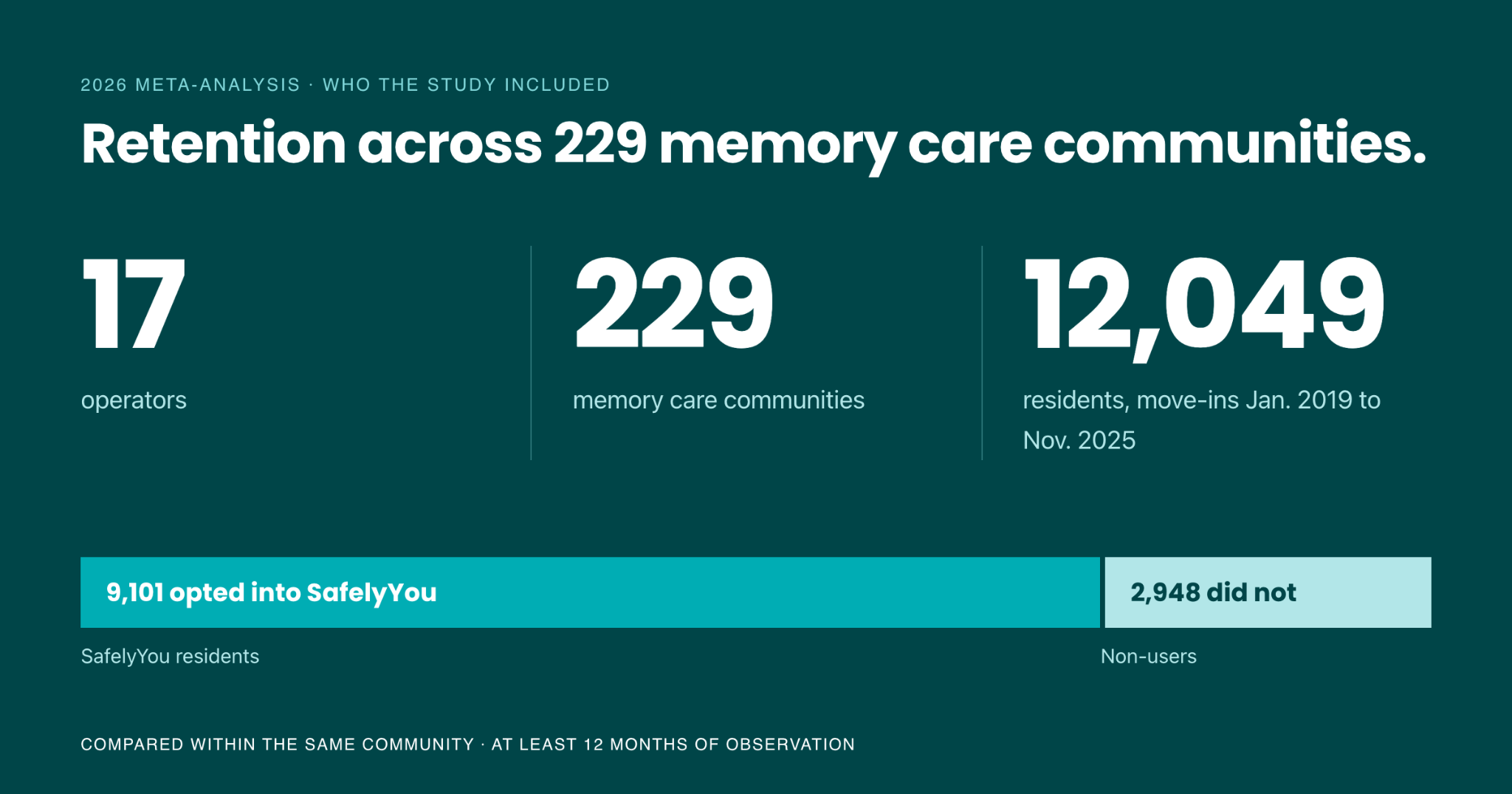
The SafelyYou Meta-Analysis pools records from 17 operators and 229 memory care communities across the United States. In all, it includes 12,049 residents: 9,101 who opted into SafelyYou and 2,948 who did not.
Move-in dates range from Jan. 1, 2019, to Nov. 1, 2025, and every community in the study had at least 12 months of observation. The analysis excludes respite stays, which are temporary by design.
A third group, residents who moved out before their community went live with SafelyYou, serves as a historical baseline.
Methodology
The study compares residents only with others in their own communities. Keeping each comparison within the same building holds operating conditions constant, so differences between operators or buildings don’t skew the results.
To anchor the findings, the study:
- Measures length of stay from a resident’s memory care start date to their move-out date.
- Tracks retention at 30, 60, and 90 days after move-in.
- Calculates annual turnover from move-outs relative to total resident days.
At the time of analysis, about 40% of residents still lived in their communities. For those residents, the study counts time only through an observation end date that each operator defined. Many of those stays will continue, so the reported gains in length of stay and retention likely understate final outcomes.
What the study found
On every measure the study tracked, SafelyYou residents came out ahead. Compared with non-users, they:
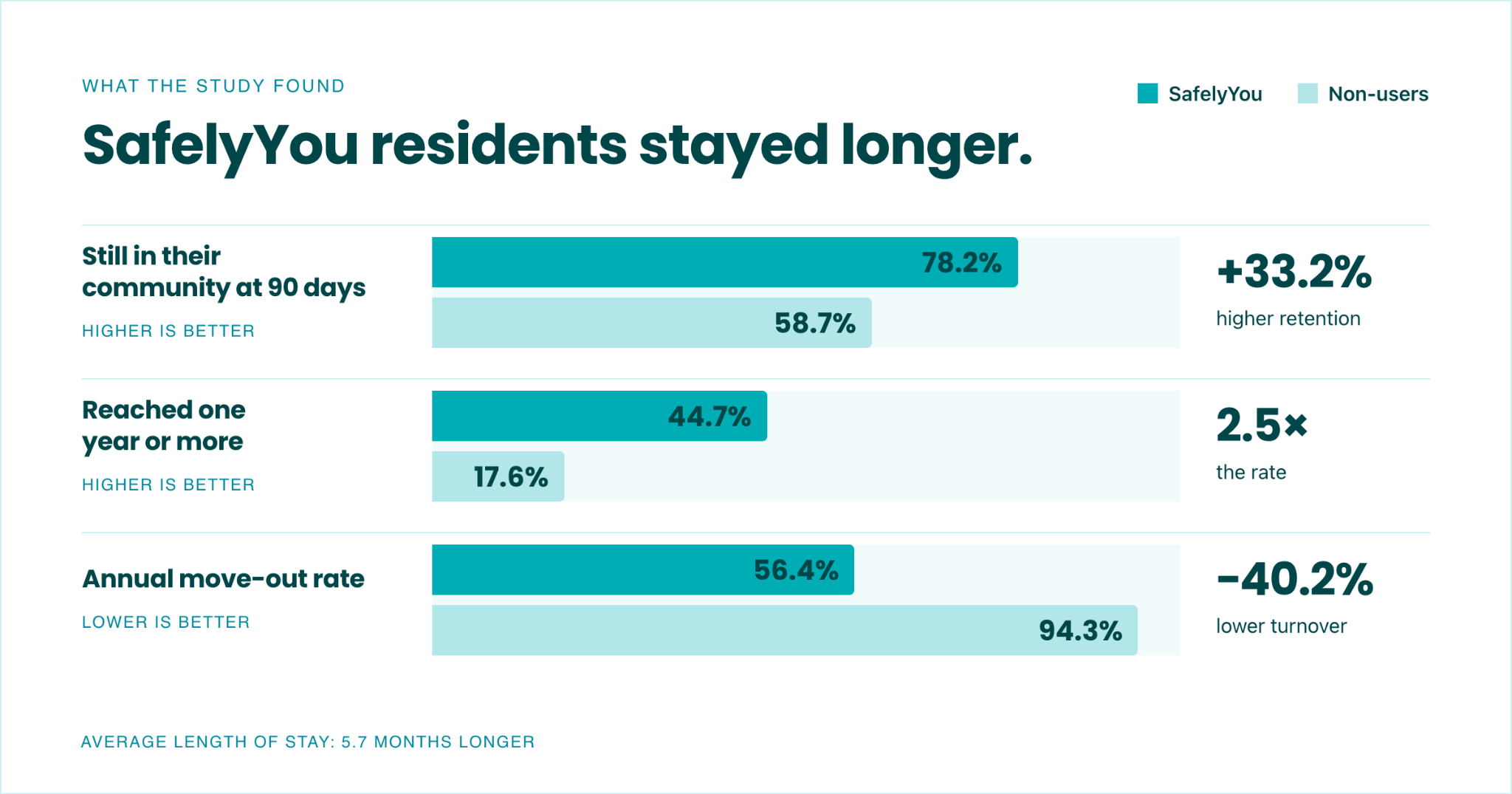
- Remained in their communities at a 33.2% higher rate through 90 days (78.2% compared with 58.7%).
- Stayed 5.7 months longer on average.
- Reached one year or more at 2.5 times the rate (44.7% compared with 17.6%).
- Moved out at a 40.2% lower annual rate (56.4% compared with 94.3%).
The median and historical baseline put those averages in perspective. A few unusually long stays can inflate an average, but the median rose by 167 days, nearly matching the increase in average stay. Residents who moved out before SafelyYou went live averaged 207 days, while non-users in the same communities averaged 226.
Adoption also moved quickly, with nearly four in five residents opting in within 30 days of their first opportunity and 94% by six months.
How longer stays add up
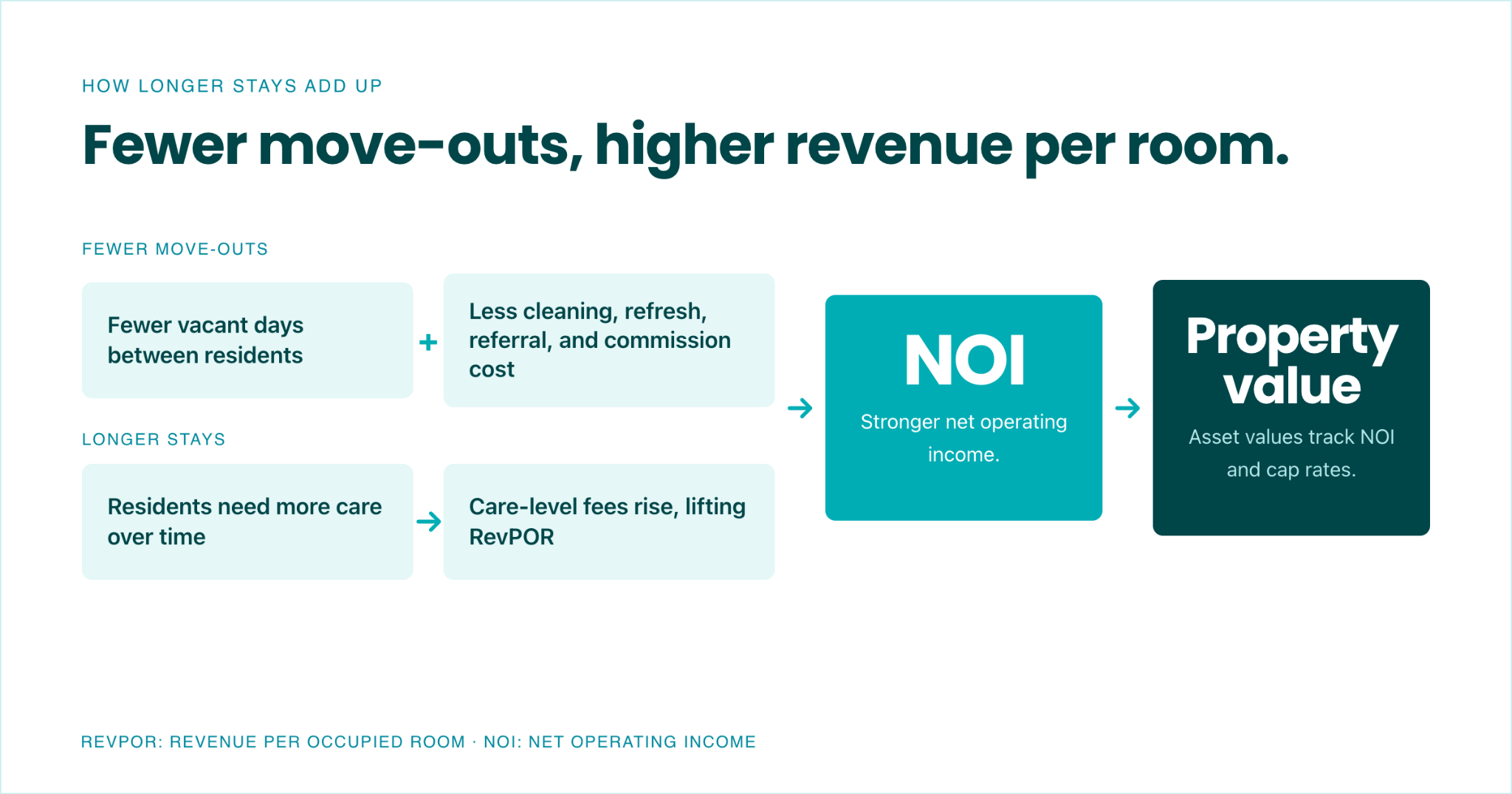
Empty units cost revenue a community never recovers. At memory care rates, a few extra vacant days between residents become costly across a portfolio. Each move-out also triggers cleaning, maintenance and unit refreshes, and many add referral fees and sales commissions. Over time, residents who stay longer tend to need more care, and rising care-level fees can lift revenue per occupied room (RevPOR).
Taken together, those effects potentially strengthen NOI. Because asset values track NOI and cap rates, a sustained lift can raise property value as well.
Teri Showalter, vice president of residential care at Merrill Gardens Senior Living, describes the impact on both residents and operations: “A five-month increase in length of stay like this has tremendous impact on both our residents and our communities. It means continued quality care for the seniors who call Merrill Gardens home and continued stability in occupancy for the communities that care for them, leading to better outcomes for the seniors we serve and our organization overall.”
What drives longer stays
Those gains trace back to the work that shapes the first 90 days: understanding what each resident needs. Clearer insight into every fall strengthens that understanding.
SafelyYou Halo® uses AI to detect falls and immediately alerts on-site staff with video of the event, so caregivers can respond quickly and see what happened. Expert clinical review and ongoing guidance help communities address unmet needs and reduce repeat falls.
Clearer information about each fall also informs care decisions and gives families a fuller account of the incident. Communities using SafelyYou see 45% fewer falls within one year and 80% fewer fall-related ER visits. Among the highest-risk residents, falls drop 82% within 90 days.
“Our partnership with SafelyYou has produced extraordinary outcomes. We’ve shown that when cutting-edge technology is paired with comprehensive clinical support, results like these are possible,” said Matt Kinne, COO of Lifespark.
See the full findings
The complete 2026 Meta-Analysis includes retention at every stay threshold, the full tenure breakdown, and the methodology behind each finding. Download the report to review the data yourself or schedule a demo to see how SafelyYou’s impact could apply to your communities.
Frequently Asked Questions
What is the SafelyYou 2026 Meta-Analysis?
It’s a study examining the impact of SafelyYou on resident retention, length of stay, and turnover across 229 memory care communities and 12,049 residents nationwide — making it one of the most comprehensive looks at how fall detection technology affects resident stability.
How was the study designed to ensure accurate results?
All comparisons were made within the same communities, not across different operators or buildings. That keeps operating conditions consistent and ensures the results reflect SafelyYou’s impact, not differences between facilities.
Why does the 90-day window matter so much?
The first 90 days are often the clearest predictor of how long a resident will stay. Residents who make it past that mark tend to stay significantly longer — which is why SafelyYou’s 33.2% higher 90-day retention rate has such a meaningful downstream effect on turnover and NOI.
Are the length-of-stay gains driven by a few outliers, or are they broadly distributed?
Broadly distributed. The average length of stay increased by 5.7 months, and the median rose by 167 days — nearly the same amount. When the median tracks closely with the average, it means the gains are spread across the resident population, not skewed by a handful of unusually long stays.
About 40% of residents in the study were still living in their communities at the time of analysis. Does that affect the findings?
Yes — and it means the reported gains likely understate the final outcomes. Those residents’ stays will continue beyond the observation window, so the true impact on length of stay and retention is probably even greater than what the study captures.