Most senior living communities don’t lack technology. They have a fall detection tool bought for one problem, scheduling software bought for another, and a wellness report for everything else. In SafelyYou’s 2026 Cost of Senior Care Study, 83% of operators reported using AI-enabled tools, but nearly half described their systems as poorly integrated. Only 37% reported positive ROI, and many said it was too early to tell because they couldn’t see enough of their own data. So, what they are actually lacking in is whole-building visibility.
That points to something bigger than an IT problem. Safety, wellness, and staffing data describe the same residents, on the same shifts, in the same building. When they’re connected, three things improve together: residents get noticed sooner, staff spend less time sorting and re-entering information, and operators can see where care and labor actually go.
What whole-building visibility means.
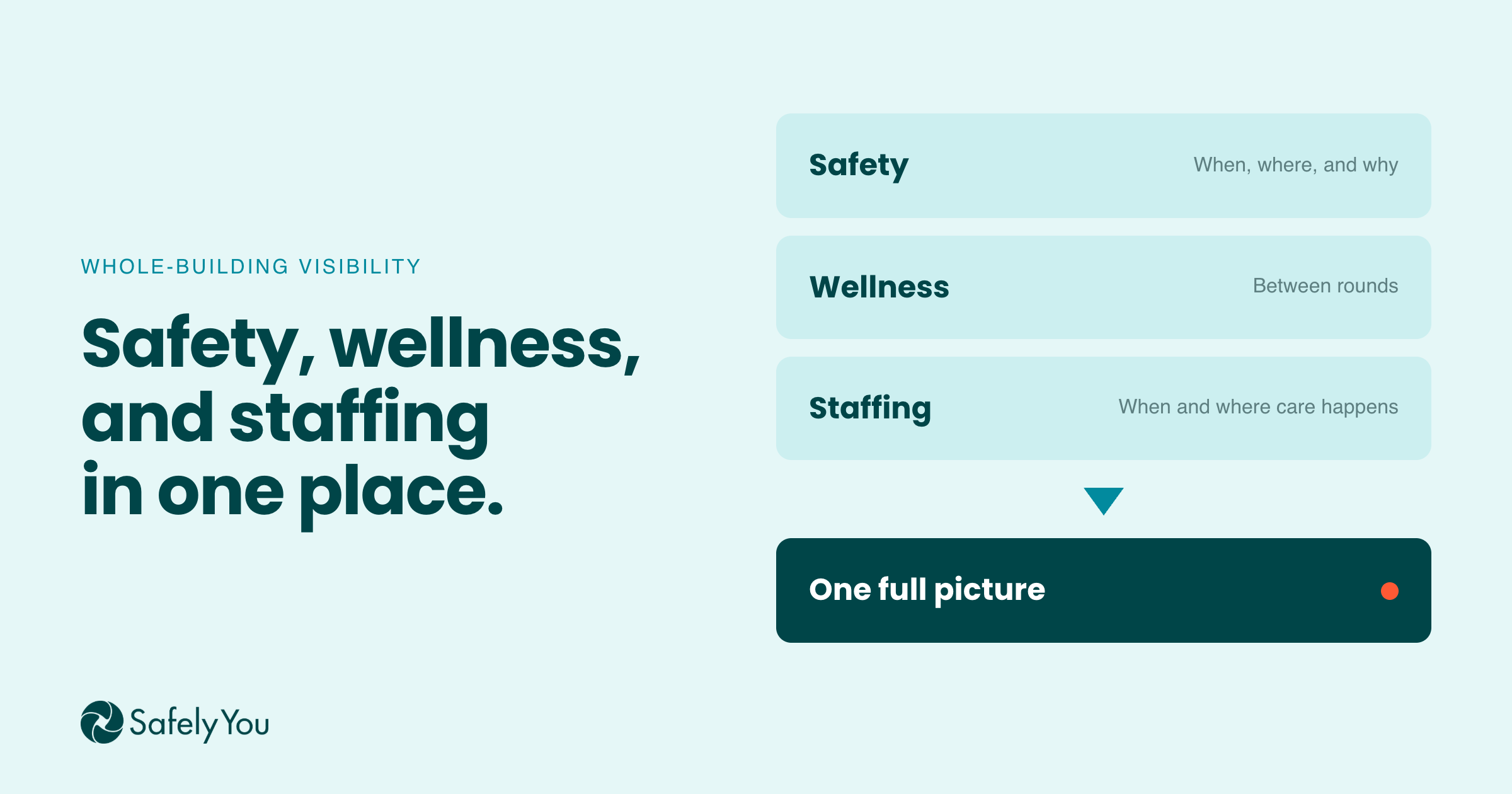
Whole-building visibility in senior living means three kinds of information in one place, covering resident rooms and common areas in both assisted living and memory care.
- The first is safety: when a fall happens, where, and why.
- The second is wellness: how residents are doing between rounds, checked remotely without entering the room.
- The third is staffing: when and where care is delivered.
SafelyYou Halo® brings these together through fall detection and review, Virtual Check-ins, and Presence Tracking. SafelyYou clinicians then join Care Huddles to look at all three together.
For residents, change gets noticed while there’s time to respond.
Falls are hard to see without help. Among the 600,000+ fall events SafelyYou clinicians have analyzed, 93% were unwitnessed. Halo alerts staff within seconds, and clinicians review the video to find the root cause, whether that’s a hazard in the room, footwear, or a mobility aid out of reach.
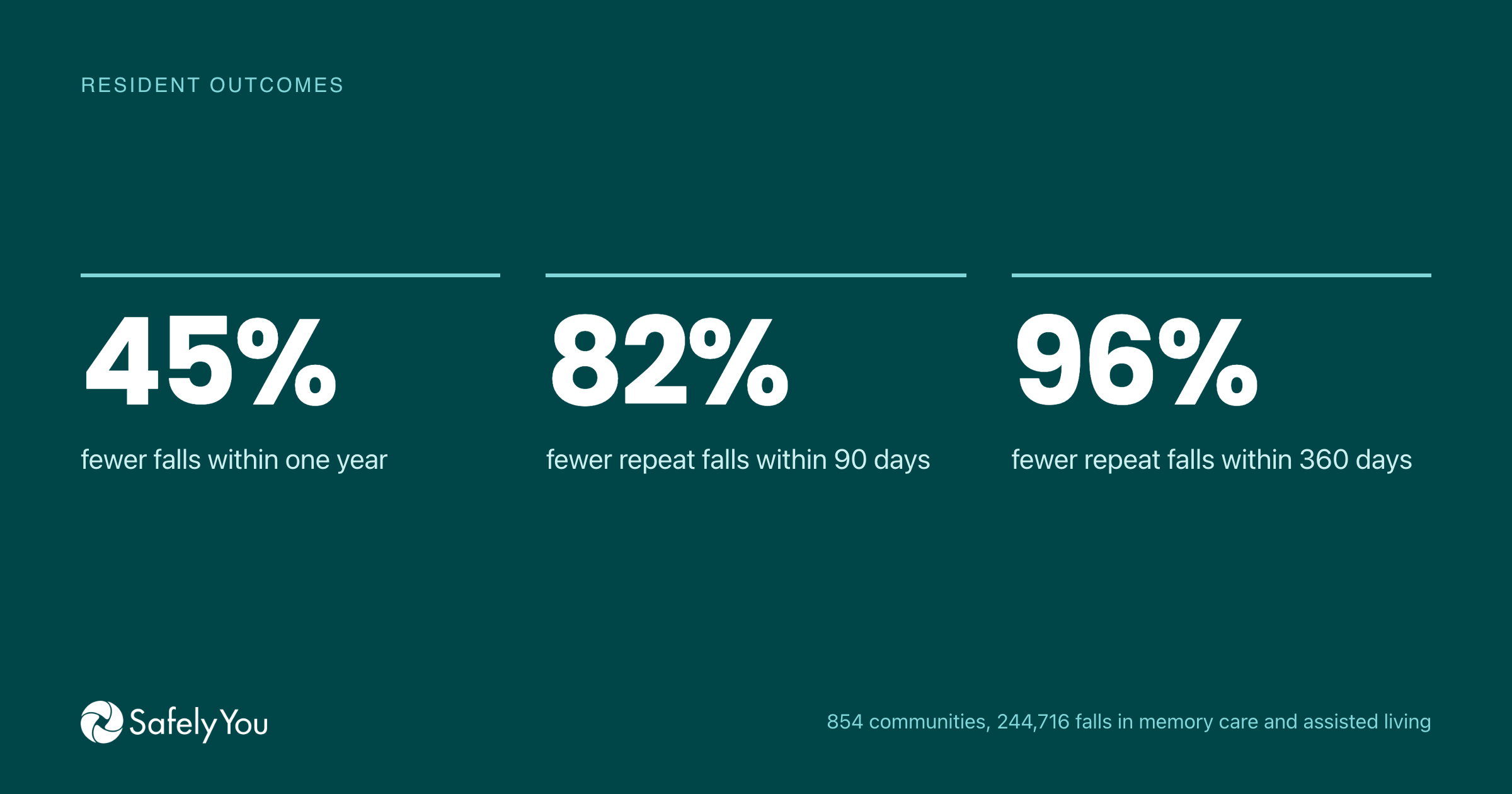
Across 854 communities and 244,716 falls in memory care and assisted living, communities using SafelyYou saw 45% fewer falls within one year. Residents who had already fallen had 82% fewer repeat falls within 90 days and 96% fewer within 360 days.
Presence Tracking adds a second signal. It shows how much time staff spend in each resident’s room, week over week, against room and community averages. When a resident’s number climbs or drops, that tells the team their needs may be changing. Leaders in the Cost of Senior Care Study report updating most care plans every one to three months or longer, so the trend gives clinical leaders a reason to reassess when the pattern appears instead of waiting for the next scheduled review.
Conversations with families about the right level of support can also start earlier, with everyone looking at the same information. Over time, that shows up in how long residents stay. In a pooled analysis of 12,049 residents across 229 communities, residents opted into SafelyYou stayed 174 days longer on average, measured from memory care service start.
One standard of care from assisted living to memory care.
Assisted living and memory care run on different rhythms. In assisted living, residents are more independent, so most change happens between check-ins: a night of poor sleep, a skipped meal, a more careful walk down the hall. In memory care, residents often can’t say what feels different, and staff read the signs from behavior. Both settings depend on someone noticing early.
A whole-building platform gives both settings one standard. The standard matters most at transitions: a move-in, a return from the hospital, a change of condition, or a conversation about moving to memory care. Those are the moments when a resident’s needs shift the most.
A fall means the same thing in either place, and so does an alert. Staff work the same workflow, whether they’re in assisted living, memory care, or covering both. The same care-time measure shows when a resident’s needs are rising or falling.
Executive directors see both settings in one report instead of comparing numbers that were defined differently. When a family and care team talk about the right level of support, they have a pattern to look at instead of only the most recent incident.
For staff, there are fewer alerts to sort and clearer next steps.
Leaders in the Cost of Senior Care Study say staff spend disproportionate time on repetitive or non-critical alerts. Each tool flags events by its own standards, so nothing tells staff what to handle first.
A connected platform gives them one workflow. An alert reaches a caregiver’s phone, and the caregiver claims it so the team knows who’s responding. If it needs more attention, it escalates through four levels of leadership. Before walking to the room, staff can use Virtual Check-ins to look at a snapshot from anywhere in the building. That helps them decide where to go first, adds to their rounding, and leaves residents undisturbed. Afterward, care activities documented in the same system build each resident’s profile, so the next shift starts with the full picture instead of whatever got said at hand-off. Clinicians in Care Huddles help turn what happened into next steps.
Administrative work shrinks too. Where Halo connects to an EHR, like August Health or ECP, fall observations flow in directly and census syncs automatically. SafelyYou’s August Health positioning describes staff spending up to two hours per new resident on paperwork across disconnected platforms, which this integration is designed to reduce.
For operations, staffing, transfers, and occupancy follow real need.
Presence Tracking shows hourly staff utilization, including the most and least demanding hours of the day. Leaders can adjust schedules to put hands where the work is, using data instead of estimates.
Better information also reduces unnecessary transfers. With Safety AI, ER send-outs ran 2.52% in 2024, compared with about 10% across the industry, even though only about 3% of analyzed falls are assessed as possible severe injury. 91% of community leaders say they’re confident admitting residents with a fall history, which supports census. SafelyYou’s Cost of Falls Report puts annual fall-related costs at an average of $380,000 per community, so fewer falls and fewer transfers matter to the budget.
The financial analysis behind SafelyYou’s ROI figures covers Safety AI in memory care. For memory care units at industry averages, it found a 3.1x return, with payback in about two months within the first year, based on length of stay and occupancy.
Connected data also gives executive directors one consistent way to measure results. Each vendor defines success differently, so a stack of separate tools makes it hard to tell whether the whole investment is improving outcomes or only adding activity. One record across both settings answers that question.
It has to work with what you already run.
Few communities can replace their EHR or nurse call system overnight, and only 15% of leaders in the study report full EHR integration with their current tools. Halo layers on top of existing nurse call and eCall systems, so teams keep what’s working. SafelyYou has documented integrations with trusted solutions like August Health, ECP, and PalCare.
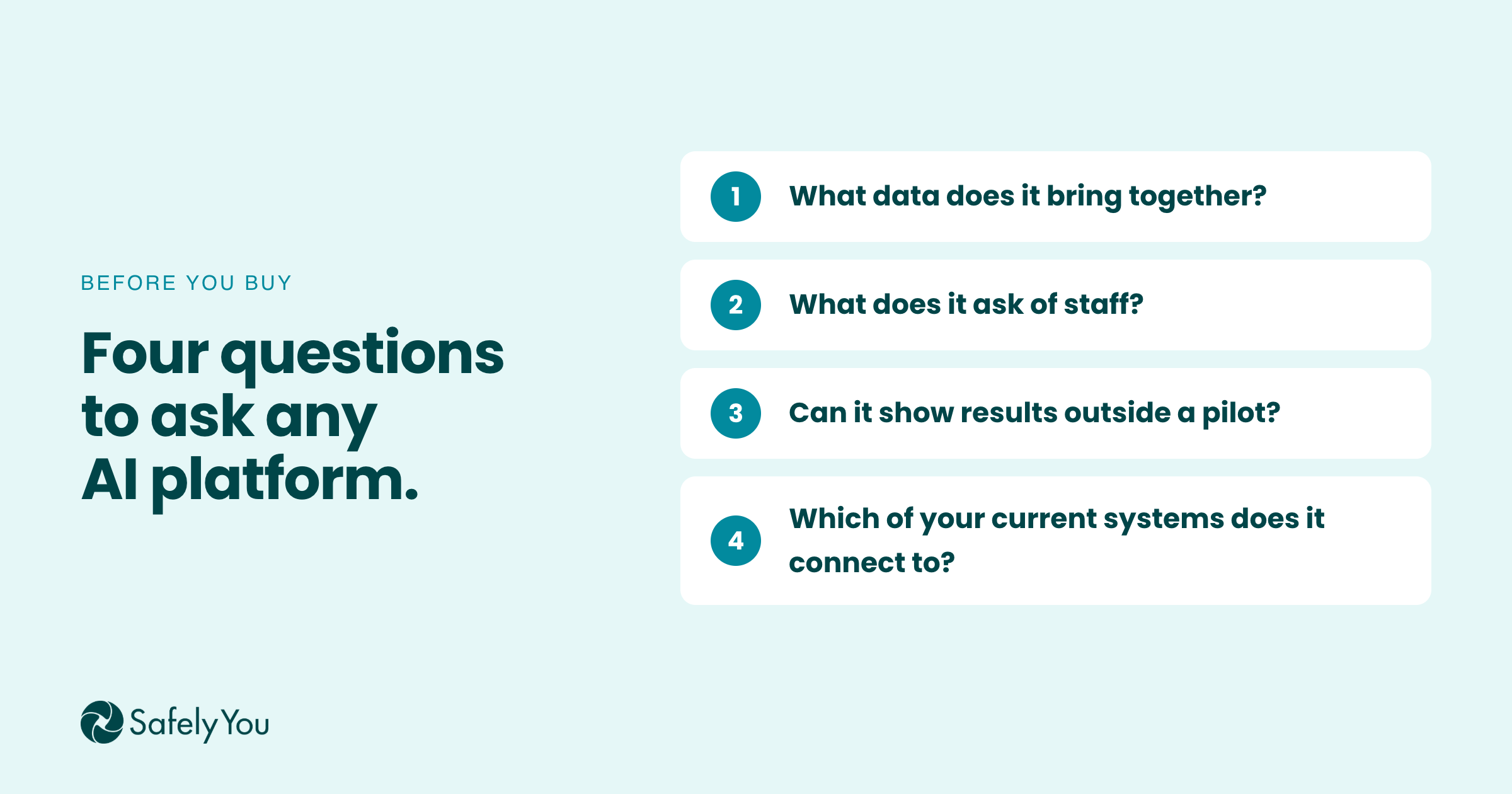
Four questions to ask any AI platform.
- What data does it bring together? A safety-only system leaves staffing and wellness in separate tools.
- What does it ask of staff? Will staff need to switch between systems or will they be able to see all the information they need in one place?
- Can it show results outside a pilot? Look for published outcomes from communities already using it.
- Which of your current systems does it connect to, by name? Ask for documented integrations.
See what the whole building can tell you.
Every new point solution fixes one problem and adds one more screen to check. A better test is how much of each resident’s story, and each shift’s story, your systems can tell. See how SafelyYou Halo gives care teams, staff, and operators the same full picture.